
A handful of smaller lakes in and around Yellowknife aren’t safe for swimming, drinking or fishing due to high concentrations of arsenic.
That’s the verdict from the territory’s chief public health officer, Dr. André Corriveau, who issued a public health advisory Thursday.
The advisory follows two recent studies that examined arsenic concentrations in bodies of water surrounding the territorial capital.
Research has found that contaminants in the lakes are linked to industrial emissions from years past when Giant Mine was still operational.
During the 50 years that the gold mine operated, thousands of tonnes of highly toxic dust went up the roaster stack and settled on the ground and lakes around Yellowknife.
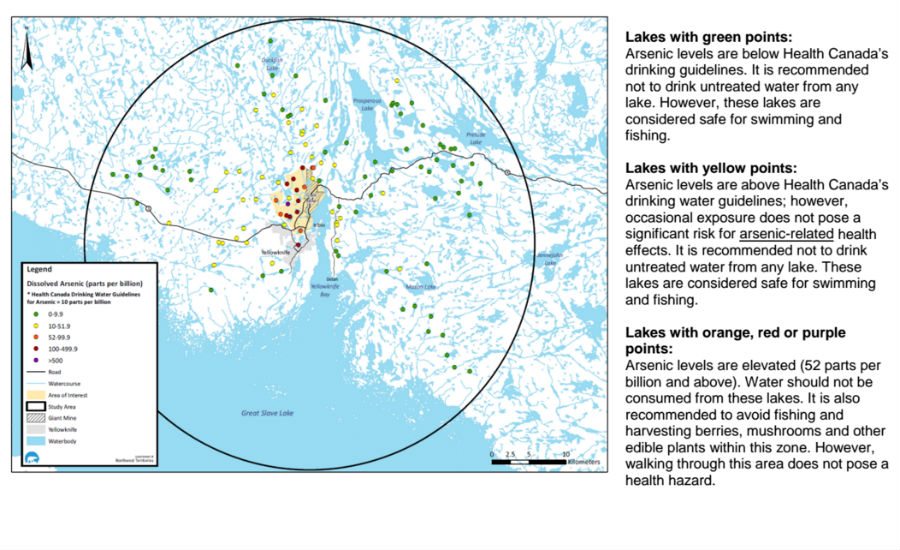 On Thursday, Corriveau told reporters arsenic concentrations are highest in small lakes near the new bypass road around Giant Mine.
Elevated levels were also observed in lakes that are downwind (north, northwest) from the mine and in lakes that aren’t connected to other bodies of water.
According to the territorial government’s Department of Health and Social Services, lakes were tested using federal drinking water guidelines which Corriveau classified as strict.
Overall, arsenic concentrations are lower than the Government of Canada’s guideline of 10 parts per billion (ppb) in Walsh Lake and Prosperous Lake.
The same can’t be said for Frame Lake, Long Lake, Vee Lake and Martin Lake however, which presented higher levels and shouldn’t be used as regular sources for drinking water.
While the public beach at Fred Henne Territorial Park is safe for swimming, people are discouraged from drinking from the lake.
The advisory doesn’t include Yellowknife Bay or the Yellowknife River, which is monitored by city officials on a regular basis.
Corriveau says he issued the public health advisory in the name of transparency. But overall, he says there’s no reason for Yellowknife residents to panic.
“We can, for the most part, continue to enjoy the recreational opportunities that surround the city … without undue concerns about risks of exposure to arsenic,” he said.
“There are no significant public health risks for residents of Yellowknife, Ndilo and Dettah and for our visitors based on the available evidence that we have gone through.
“I don’t think that some of this information will be a total surprise for most of us who have been living here in Yellowknife for a long time.
“But I think it’s important that we be transparent and provide information to incoming residents and visitors on the state of our living environment.”
Even though several lakes in and around the city shouldn’t be used as sources for drinking water, Corriveau advises against drinking untreated water anyways.
He says residents won’t be putting themselves in harm’s way unless they’re regularly exposed to higher concentrations over a long period of time.
“Our favourite camping grounds, fishing areas and beaches remain great places to visit and enjoy with our family and friends,” said Corriveau.
“There’s very poor absorption of arsenic through the skin. But when people swim they could swallow water so that’s why we provide that note of caution.
“It’s really a note of caution so people can make their own decisions about this risk.”
In the months to come, the territorial government will be working with the City of Yellowknife to erect signs telling the public about the high levels.
Another study examining arsenic concentrations in Yellowknife lakes is expected to be published this summer.