Hay River’s Northern Farm Training Institute believes “the birth of farming as a genuine, viable industry” may be taking place in the Northwest Territories.
And soon, it hopes, you will buy your produce direct from an NWT farm.
The Northern Farm Training Institute, or NFTI, has been chosen as a candidate to become the sole Canadian representative for an international non-profit named the Savory Institute.
The institute, founded by farming environmentalist Allan Savory, claims its work worldwide helps farms become “economically, socially, and environmentally regenerative” using principles of “holistic management” that are central to Savory’s philosophy.
The NFTI is now one of nine candidates – and the only candidate in Canada – to become a ‘hub’ for the institute. Other candidates are based in the US, UK, Malawi, Australia, Thailand and Costa Rica.
Hay River’s farm-in-the-making needs to meet certain criteria by this fall to achieve full hub status.
Jackie Milne, the NFTI’s founder, told Moose FM she believes this announcement will transform the nature of farming in the North, leading to new jobs and commercial opportunities.
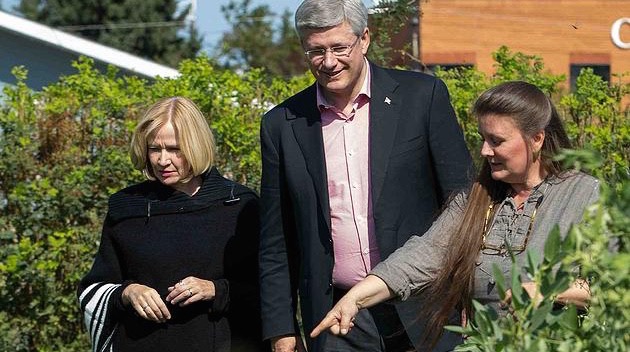
“We will become a centre to serve all of Canada. Students from across Canada who want to learn holistic management will come here. This is instantly an industry for us as a community,” said Milne (pictured, above right, with students).
“This could be the birth of a genuine, viable industry in the Northwest Territories. We spend $150 million a year on food and that money is a total drain – the bulk of it is paying for imports.
“If we just captured 10% of that in Hay River, that’s $15 million. Well, the whole commerce of trade in Hay River is $20 million. Just with farming we could double our trading dollars in this community. Imagine that going out into all the communities in the North.
“The Northwest Territories, in time, could export choice products. We could get into reindeer farming. We could grow organic food up here so easily, because we don’t have the same kind of pest loads that they have down south. It could just be marvellous, really marvellous for us.”
The NFTI is using its $2 million grant from CanNor – announced by the Prime Minister, Stephen Harper, during his visit to Fort Smith last August – to fund a raft of new buildings.
Greenhouses, a food handling and processing facility, a barn, fields for cultivation, and accommodation blocks are all set to be built.
“We’re physically building a farm. This is going to be a real business,” said Milne.
“Our school is going to produce food and sell it, and that’s part of our long-term plan for sustainability: the ability to generate revenues so that this process is self-sufficient.”
Milne’s long-term plan calls for the NFTI to grow and sell a wide variety of farm produce, under the guidance and supervision of the Savory Institute, while generating additional revenue from students and tourists.
Her vision is to ship goods to neighbouring NWT communities – including Yellowknife – using a system where residents subscribe to receive regular boxes of produce (similar to this one).
Milne hopes you will be able to buy everything from fruit and vegetables to eggs, meat and dairy directly from the NFTI in years to come.
“We will have animal products, then all the appropriate outdoor crops – potatoes, carrots, onions, beets – and of course greenhouse crops like tomatoes, cucumbers, peppers,” she told us. “Then we can have hardy orchards, which would be predominantly berries. Then there are potentially hardy grains, like barley.
“Once you have your base product, that creates a foundation for the next level of industry, which is value-adding – making something out of the food. We can serve our restaurants, local people who want to do canning, processing, making jams, garments, felting. Once we get that fundamental entry-level production, it has a snowball effect.
“What we will do is probably sell the product through a system called a CSA – customer-supported agriculture. It’s a box, like a subscription. They sign up and every week they get a box of produce. This is a way produce can be economically and affordably delivered to neighbouring communities.
“Everyone subscribes, you have a van full of produce and you go to Yellowknife.”
Milne says the NFTI is in the process of finalizing a land agreement with the Town of Hay River, giving it access to up to 200 acres of land. She says that is “perfectly adequate” for the farm’s plans.
The NFTI hopes to grow from a handful of employees at present to up to 20 people “once everything is in place and operating”.
The first step, however, will be passing the Savory Institute’s accreditation process and graduating to full hub status.
“The next steps are for members of our management team and on-the-ground team to go through a series of training ourselves, in understand the principles of holistic management,” said Milne.
“For us in the North, what this gives us is a platform to go forward, to break the vicious cycle of land degradation.
“Let’s take the NWT border. Let’s say that’s a line, and we’re drawing this line and saying ‘OK, the destructive agricultural practices that have been with humanity for thousands of years stop here.’
“This is giving us an opportunity to catapult into the future. It’s a gift to all the people in the North.”