



100.1 GO FM - We're Your Feel Good Pop Station

Study says NWT bison are being displaced by climate change

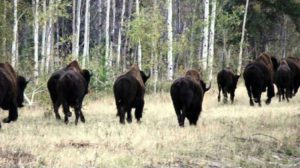
New research indicates that wood bison in southern regions of the NWT are being displaced because of the effects of climate change.

Researchers from the University of Ottawa, five partner universities and the territorial government argue that climate change is causing extensive lake expansion and landscape flooding in the area.

RELATED: Wood bison listed as threatened species in Northwest Territories

That’s affecting the core habitat of a wood bison population that is already vulnerable and listed as threatened under the NWT Species at Risk Act.

“The Mackenzie Bison Sanctuary, on the north shore of Great Slave Lake, is home to an important population of wood bison,” said Jennifer Korosi, co-lead author of the paper, published in the journal Nature on Thursday.

“Observations over the last decade by local land users and wildlife managers suggest that the lakes of the region have expanded, flooding large areas of sedge meadows.”

As part of the study, researchers analyzed satellite images taken between 1986 and 2011.
Their findings show that lake surface areas nearly doubled over that period – a phenomenon that has had a significant impact on bison herds in the area.

“As the lakes have expanded, the Mackenzie herd appears to have abandoned the former core of its range within the protected area of the sanctuary in search of forage,” said co-author Michael Pisaric, a professor at Brock University.

Pisaric argues that those habitat changes have forced herds elsewhere, increasing the risk of bison-vehicle collisions along Highway 3.

In addition to analyzing satellite images, researchers also looked at soil and sediment samples in the area.

Their research confirmed that flooding of the landscape over the past two decades is unprecedented in over 200 years – a clear indication that climate change is to blame.

“Our findings clearly indicate that increases in lake size, as a result of climate change, have directly impacted the use of the land by threatened wood bison,” added Jules Blais, co-author and professor at the University of Ottawa.

Less than a year ago, wildlife officials estimated there were fewer than 2,500 wood bison remaining in the Northwest Territories.

It’s believed that the territory is home to 32 per cent of the world’s wood bison population. As the largest land mammal in North America, they are important grazers and a key component of the boreal forest ecosystem.

But remaining herds are facing a number of legitimate threats, including disease, increased predation and human-caused death.


Mike Gibbins
Mike Gibbins
Hello and thank you for listening to 100.1 Moose FM! To contact me, you can email me, find me on Twitter or call (867) 920-4663.

Continue Reading

You may also like


cjcd Now playing play

- Advertisement -

Related Articles

- Advertisement -

Latest News

Infrastructure in most south and north regions, focus of N.W.T. capital plan

The GNWT’s proposed capital spending $436 million is concentrated heavily between the southernmost and northernmost regions. The capital estimates report shows a focus on infrastructure development on highways and roads (30 per cent, about $130 million of total capital spending), community infrastructure (16 per cent, about $70 million),  renewable energy (16 per cent, about $70 million) and housing (12 per cent, about $52 million).

Snowking rising on Yellowknife Bay in Art Deco style with hot lineup of acts

Snowkings announce a much anticipated XXXI Festival schedule of events and performer lineup to take place within the walls of an Art Deco-themed winter castle. Edition 31 of the Snowking festival is coming to life, rising from the snow and ice of Yellowknife Bay. “This year will be jam-packed with talented performers and day-time and evening events all within the impressive Art Deco themed architecture of this year’s Snowcastle,” said Taylor Shephard, aka ‘Sir Slush’

Series of “mock testing” using virtual tech to take place at Inuvik hospital

“We're expanding to have audio scopes and stethoscopes and we're looking at other tools that can be used. So that the virtual care out of Stanton or Inuvik can be provided into our smallest of communities. So a physician has always been available in those locations, via phone or travelling to them. But now we're offering a broader base. Connectivity has been resolved in part by using what's there, investing in new technology - so satellite connectivity,” said Dan Florizone

North braces for public service impact, where ‘small’ cuts run “deep”

"The impact on Northern and remote and Indigenous communities where we already know sometimes there is one position in the community, there is only a skeleton crew providing services can be felt definitely by Northerners who depend on certain services that are crucial to them," warns Josée-Anne Spirito, regional vice president at the Public Service Alliance of Canada.

Imperial Oil to end Norman Wells operations by summer 2026

Imperial Oil Ltd. will end production at its Norman Wells facility in the Northwest Territories in summer 2026.


