



The salaries are great, the cost of living in the NWT is not.
That’s the verdict of the latest mining employee survey.
The survey is the first of its kind since 2009. More than 2,500 employees answered, across the territory’s four diamond mines.
While the availability of work and high pay were given as good reasons to live in the NWT, many workers said the cost of living stops them becoming full-time residents of the territory.
The cost of living has long been an obstacle to the territorial government’s objective of increasing the population.
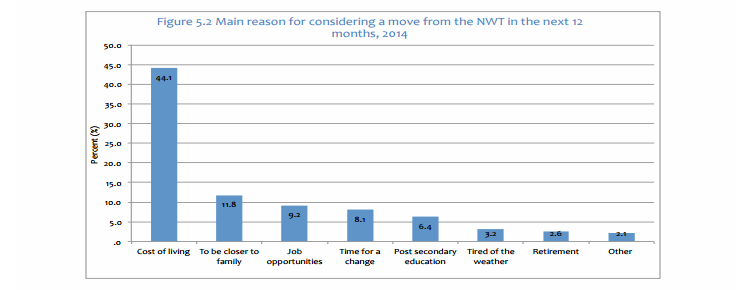
Around 40% of surveyed mining employees currently residing in the NWT said they were considering leaving. More than four in 10 of those employees listed the cost of living as the main reason.
By comparison, the next most popular reason – being closer to family – was a factor for just one in 10.
More than half of the surveyed employees, however, don’t live in the NWT. They work at the territory’s mines but commute to the NWT, usually from either Alberta or BC.
Employees who currently live elsewhere were asked to list their main concerns about a move to the NWT. More than 80% listed the cost of housing and the cost of utilities.
The proportion of mining workers commuting to NWT mines from outside the territory appears to have risen. In 2009’s survey, 57% of workers lived in the NWT. That was down to 46% last year.
Read: The full 2014 NWT Survey of Mining Employees report (pdf)
Aside from employees’ feelings on life in the NWT, the survey also gathered basic information about who works in the territory’s mines.
More than four in five of the territory’s mining employees are male, according to the survey. Roughly 30% identify as Aboriginal.
Around 900 employees said opportunities for career growth in the NWT were limited. A lack of openings was the biggest reason, but 70 respondents – 7.8% of that total – listed “ethnicity and favoritism” as the problem.
The survey was conducted by the NWT Bureau of Statistics between August and October last year.





