The price of morel mushrooms could disappoint thousands of harvesters this summer.
That’s the warning from a leading mushroom expert at an information session held in Yellowknife on Tuesday.
The territory is expecting its biggest-ever morel mushroom harvest in the burn areas left behind by last year’s devastating forest fire season.
People across the NWT, Canada and beyond have been enticed by the prospect of earning hundreds of dollars each day, simply by gathering the mushrooms – a delicacy at restaurants worldwide – and selling them to roadside buyers.
Northern communities have been shown examples in which people earned tens of thousands of dollars in past seasons, based on prices at around $14 per pound.
Read: Our updated guide to morel mushroom picking
However, biologist and mushroom harvesting specialist Joachim Obst now warns that this summer’s crop may be nothing like as lucrative.
“Prices were pretty high during the last three years,” Obst told residents during Tuesday’s lunchtime session at Yellowknife’s Northern United Place.
“This year, I was called up by buyers and they told me, ‘We are not going to pay $14 this year because world prices are expected to drop by as much as, maybe, 50 per cent.’
“They expect a huge crop this year, not only in the NWT, but there were also a couple of fires in southern BC. It could be that, this year, you only see offers between $6.50 and $8 per pound of fresh morel mushrooms.”
If that’s the case, Obst says, there is still good money to be made from the harvest – but you must be prepared to work longer hours than the four-hour shifts previously used as examples.
“A person who works a normal day – so, longer than four hours, let’s say – still could make a few hundred dollars in a day,” said Obst.
“A fit person could easily still make $700 or $800 a day, even with low prices.”
Obst recommends checking the price of morel mushrooms on eBay, at regular intervals, for a sense of where the market is going.
He noted that prices paid by roadside buyers gradually increased during last year’s harvest in the Deh Cho. So, even if prices start low this year, they may yet reach the highs of previous years.
Forest fires remain a concern this summer.
If, as some have forecast, the Northwest Territories experiences another bad fire season, many ideal mushroom-harvesting areas may be inaccessible. If burn areas once again catch fire, some of the multi-million-dollar mushroom crop could literally go up in flames.
If forest fires threaten the supply of mushrooms on a large scale, that may help to push up the price paid.
One theme of Tuesday’s session was personal safety: mushroom pickers must be prepared for everything from forest fires, to falling trees, to sharp knives.
If you intend picking mushrooms, consult the territorial government’s handbook before setting out.
Download: NWT government’s morel harvesting guide (pdf)
Scott McQueen, from the territorial government’s department of industry, tourism and investment, acknowledged the phenomenal interest in this year’s mushroom crop.
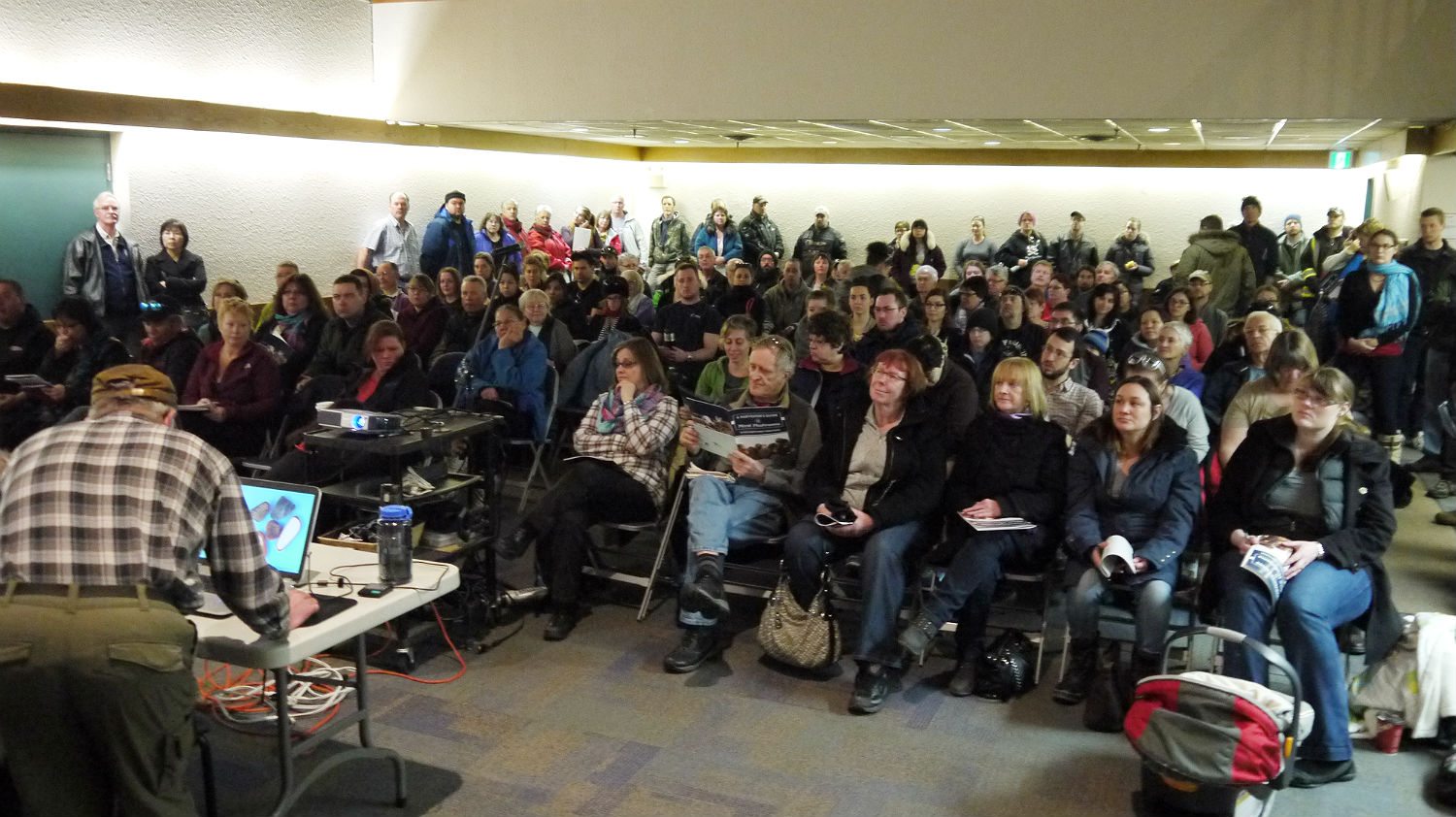
More than 200 people packed into Tuesday’s venue, with many forced to stand. Hundreds of other NWT residents have already attended similar seminars in smaller communities.
“Everybody’s looking for a way to make some extra money,” said McQueen.
“To me, the great thing about morel mushrooms is that what you put into it, you get out of it. If you go out and pick for one hour you’ll make a small amount of money, but you’ll probably spend as much on gas to get out there.”
Despite concerns about the price, McQueen said the experts he works with remain buoyant about the possibilities this summer.
“It’s really funny to drive along the highways with these morel mushroom specialists,” he said.
“They see the burn area and, to me, it’s just a big, dead area. But they start bouncing in their seat a little bit, they get all excited.”
Shauna Zorn was a member of Tuesday’s audience.
“I didn’t know what it was until I heard you talking about it on the radio,” she admitted to Moose FM.
“I’m at home with my daughter for the summer so, instead of going to work, I’ll be ‘going to work’ with mushrooms.
“It doesn’t matter to me what it’s going to be worth, because I’m going at it thinking about learning.
“If it goes well and we have fun, I’ll get serious about it. For this year it’s just go out, learn, have fun and see what we can find – without poisoning ourselves.”