


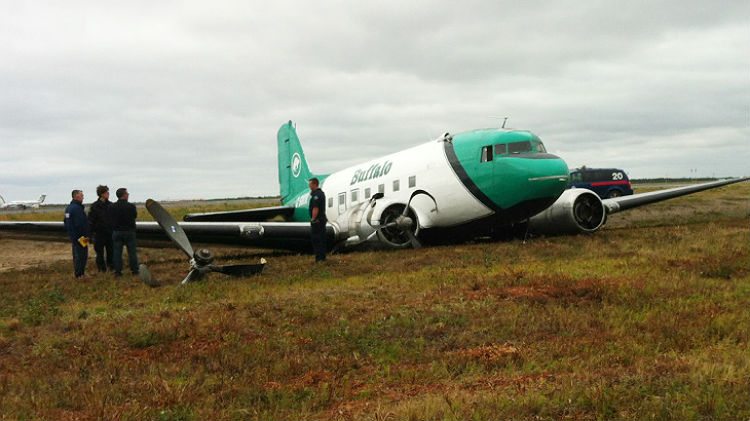

The Transportation Safety Board of Canada (TSB) has criticized the “organizational culture” at Buffalo Airways in its report into a crash landing in Yellowknife two years ago.
On August 19, 2013, a Buffalo DC-3 leaving Yellowknife for Hay River suffered a fire in its right engine while taking off.
The aircraft struck tree tops as the pilot made a low-altitude bid to return to the airport. Eventually, the plane landed short of the runway with its landing gear still retracted.
All 21 passengers and three crew escaped unharmed. At the time, Buffalo’s Joe McBryan told the CBC “it was quite smooth other than the very end”, adding: “I think the crew did a marvellous job under the circumstances.”
However, Monday’s TSB report concluded that, while a cylinder had failed on the right engine, the aircraft had also exceeded its maximum certified take-off weight.
In full: TSB’s report on Buffalo “collision with terrain”, August 2013
The TSB’s investigators felt Buffalo often paid too little attention to the weight and balance of the airline’s aircraft.
“The aircraft departed without a completed weight and balance calculation [and] the investigation found that it was common to operate in this manner,” reads the report.
“Weight and balance forms were normally completed en-route, without the benefit of accurate information and without using standard or actual passenger weights as required.
“There were other indications that the organizational culture at Buffalo Airways was not supportive of a system that required the organization to take a proactive role in identifying hazards and reducing risks.”
Investigators believe that day’s flight was some 1,235 lb above its maximum certified take-off weight of 26,200 lb.
Buffalo and the TSB both say steps have been taken to change the airline’s practices since the 2013 accident.
“Buffalo Airways has begun to enforce the practice of weighing individual passengers and baggage in order to calculate a weight and balance prior to departure,” noted the TSB.
Among other changes, Buffalo has now revised its operations manual and provided “comprehensive re-training” for its operations manager, as well as hiring a consultant “to assist with regulatory compliance”.
In its report, the TSB also criticizes the level of oversight provided by Transport Canada.
“If Transport Canada does not adopt a balanced approach that combines inspections for compliance with audits of safety management processes, unsafe operating practices may not be identified, increasing the risk of accidents,” reads the report.
On the day of the accident, passengers on the flight praised the actions of the pilot after the engine fire developed.
“Had we gone totally into the trees, it would’ve been game over,” passenger David Connelly told the CBC.






