


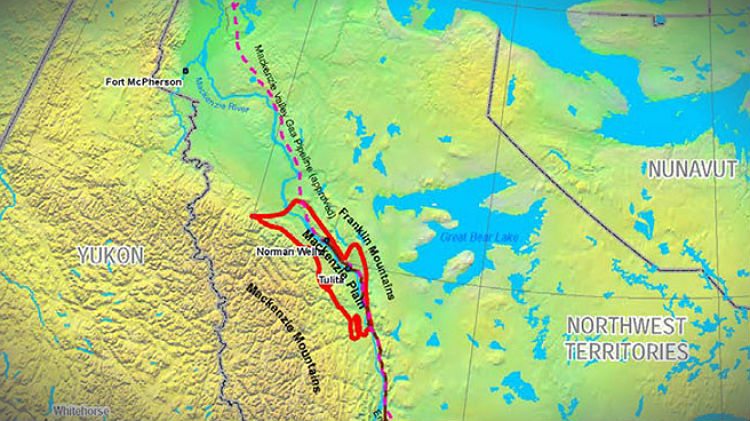

The central Northwest Territories is home to around 200 billion barrels of oil, according to a new assessment released on Friday.
Canada’s National Energy Board (NEB), working with the NWT’s Geological Survey, says the Canol Shale holds an estimated 145 billion barrels of oil, with the Bluefish Shale accounting for a further 46 billion barrels.
According to the NEB, this is scientists’ first real insight into the size of these reserves, located west of Great Bear Lake.
“The numbers are staggering,” David Ramsay, the territorial minister of industry, tourism and investment, told Moose FM.
“We’ve known there’s oil there but when you put numbers to it, those numbers are quite large and quite exciting for the Northwest Territories.
“This is a resource that we get to manage now, in looking at jobs and opportunities for the people of the Northwest Territories.”
Full announcement: NEB and NTGS assess Bluefish and Canol Shales
However, Ramsay noted that extracting any of the oil will require the use of hydraulic fracturing, or fracking.
Fracking remains a contentious issue in the NWT. The territorial government is proposing a new regulatory framework to govern the practice, but the Dene Nation, among others, has called for a slower approach so people can “learn about the process and the risks involved” before decisions are made.
“If there’s no hydraulic fracturing, those resources can’t be extracted,” admitted Ramsay.
“We have to continue to balance the environmental concerns and also the economic concerns – the jobs and prosperity for the region.
“This is something that we can’t afford to mess up. It’s up to us to manage it – and better us than a government 3,000 miles away.”
Read: GNWT unveils new proposed fracking regulations
Putting the numbers into context, Ramsay said the discovery is “not as big” as major oil reserves in Alberta or South Dakota, “but it’s large enough that it will certainly get people’s attention”.
However, in Friday’s announcement, the NEB conceded that nobody is yet sure whether the two shales are capable of commercial production – despite their apparent size. The NWT’s lack of infrastructure also makes exploiting the deposits more challenging.
“If only one percent of the in-place resource could be recovered from the Canol Shale, it would represent a marketable resource of 1.45 billion barrels,” noted the NEB’s statement.
Three years ago, Ramsay said two to three billion barrels of recoverable oil would be the top end of his expectation. He nows say more exploratory drilling is necessary to better understand how much oil is realistically available.






