
TerraX Minerals, the company trying to bring back the city’s gold mining industry, is planning to spend a massive $40.375 million on its Yellowknife City Gold project over the next three years.
RELATED: TerraX to begin drilling for gold south of Con Mine
RELATED: TerraX hoping to conduct exploratory drilling near Con
Last year, the company spent $7 million on the project, over $5 million of which was directly in the city.
As part of its three-year plan, the company plans to spend $10 million this year alone.
Of the over $40 million budget, roughly $32 million will be spent on drilling, while around $8 million will go towards things like fieldwork, supplies and travel expenses and initial testing of six zones.
Drilling on TerraX’s Northbelt and Southbelt properties has already begun. For now, the company is only drilling about 200 meters down to collect samples to be analyzed for gold.
Area exploring tripled
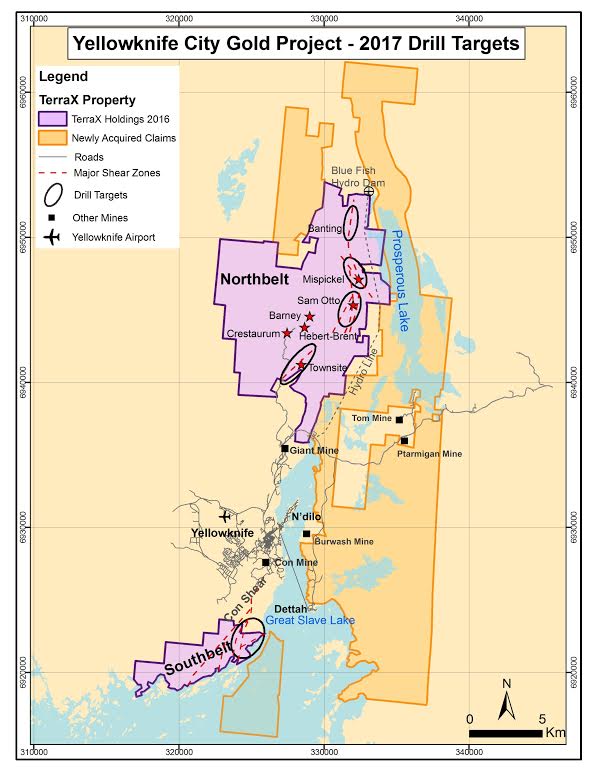
The company recently tripled the land around Yellowknife it’ll be exploring for gold.
In an email, TerraX told Moose FM the areas it’s exploring now includes an extension of its Northbelt property to add portions of Prosperous Lake.
The company is also exploring an extension of the Campbell Shear, previously part of the Con Mine, and an area across from Old Town.
Exploring those areas isn’t new. Over the past 80 years they’ve been checked multiple times, but TerraX says it’s confident that with new technology they’ll discover that there’s still more to be mined.
It will take anywhere from eight years to a decade before the company will be in a position to look at mine development according to TerraX President and CEO Joe Campbell.
“We’re very early on in the stage yet,” he told Moose FM.
“It’s highly prospective, we have a lot of confidence that we’ll be able to move this project forward but we still have a long way to go.”
Cabin owners, dog sledders affected
While none of those areas fall on residential property, the company says it could impact cabin owners, along with the ski club and snowmobilers.
RELATED: Meet the man who wants to bring another gold mine to Yellowknife
TerraX’s newly acquired Southbelt area is also located in a popular spot for sled dog trainers.
“That’s another group that uses the land, and we have to make sure that we don’t interfere with what they want to do and they understand what we’re trying to do,” Campbell said.
Campbell says the company has posted signs at access roads so employees stay on the lookout for mushers, and have designed its roads not to overlap with commonly used trails.
“TerraX has formed a co-user committee of the outdoor recreation groups that use the trails,” added David Connelly, a spokesperson for TerraX.
Connelly says the group is chaired by the ski club and includes the snowmobile, the radio club and a number of other clubs to ensure the safety of the trails.
TerraX will hold its fourth annual community consultation and public information meeting at the Yellowknife Ski Club Wednesday night at 7:30.
Employment
Campbell says TerraX is embracing the catchphrase “live where you work”, aiming to employ as many NWT residents as possible.
“Right now in the city people are worrying about the economic activity,” said Campbell.
“There’s been a slight decrease in population, you’ve lost some head offices from the diamond activity. This is an opportunity in a mine that will employ people in the Yellowknife area.”
However, at a public meeting Wednesday morning, Campbell couldn’t provide an answer for how many people the company employed in 2016.
In a follow-up with Connelly, he said about two-thirds of employees on the project are from the North.
It was noted though that the company is behind in employing First Nations people. In previous projects, 35 per cent of TerraX employees were Indigenous, but for the Yellowknife City Gold Project they’re much lower.
“We’ve been trying really hard to bring in as many people as we can from the local area to take on those jobs, and we’re going to continue in those efforts,” said Campbell.
“We want to see our local input of employees increase over the next couple of years.”
Currently the company has 50 people working on the project.
Since the Southbelt project is relatively short-term, drilling on the company’s Northbelt property is planned to last nine months at a time with small breaks for holidays.
The company employs geologists, who are harder to train, from outside of the territory but says it will hire locals and train them as geo-technicians, field hands and core cutters.
“This is a unique opportunity in the North where the centre of operation is actually going to be in the city,” said Campbell.