
100.1 GO FM - We're Your Feel Good Pop Station

Cost of cannabis up in Canada, NWT since legalization: Stat Can

The price of cannabis in the Northwest Territories and across Canada has risen since legalization says Statistics Canada.

A Stat Can report states the average price of legal and illegal cannabis has risen from $6.85/gram to to $8.05/gram after legalization.

In the Northwest Territories, a gram of cannabis cost an average $12.71 before legalization. Consumers are now paying $14.45/gram. This is a close to $2 – over 13 per cent – increase.
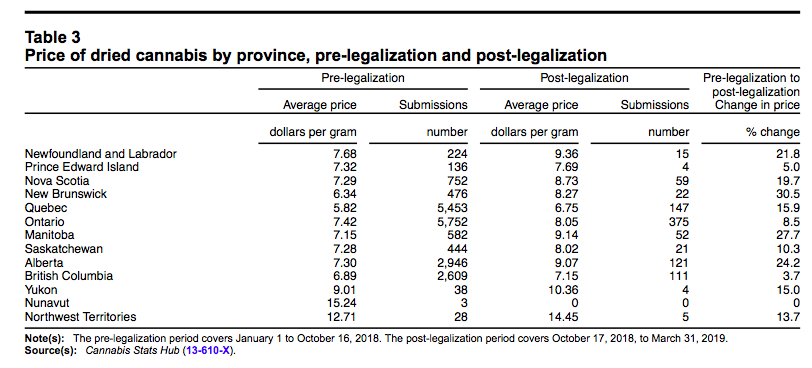
Price of cannabis in Canada’s provinces and territories, before and after legalization. Stat Can image

The NWT has the highest price of cannabis after legalization across the country, however, there is no post-legalization price for Nunavut as no answers were submitted. Nunavut had the highest pre-legalization average price of $15.24/gram.

READ MORE: What you need to know about legalization in the NWT

While prices for cannabis are high in the NWT, the biggest jump after legalization was in New Brunswick and Manitoba where prices rose 27 to 30 per cent.

The data also showed all consumers, no matter how frequently they used cannabis, were paying more for their product after legalization.

“Infrequent consumers, or those who use a few times a year, were paying 27.2 per cent more per gram of dried cannabis, while more frequent users, or those who consume daily, were paying 14.8 per cent more since legalization.”

Those who bought their product from government licensed stores ended up paying the most, at an average of $10.73/gram across Canada.

The data also found legal cannabis 60 per cent more expensive than cannabis bought on the illegal market – $9.99/gram versus $6.37/gram.

The information comes from crowdsourcing, Stat Can says. They warn these numbers could involve ‘statistical bias’ because participants self-select and a small number of responses are submitted, especially in the territories. The NWT had 28 people submit responses before legalization and five after.


Emelie Peacock
Emelie Peacock
News Reporter

Continue Reading

You may also like


cjcd Now playing play

- Advertisement -

Related Articles

- Advertisement -

Latest News

YK Women’s Society and RCMP working towards “reconciliACTION”

“We recognize and understand that trust must be earned, that healing takes time and that reconciliation is not a gesture but a responsibility. We all must work collectively towards reconciliACTION,” said the Yellowknife Women’s Society and the N.W.T. RCMP in a joint statement issued on Dec. 10.

NWT youth to receive gender affirming care outside Atla.

GNWT health officials say they are working to bridge gaps for Two Spirit, Trans and gender diverse youth with provinces like B.C. after Alta passed a controversial law this week to restrict gender-affirming care. On Dec. 10, the province’s legislative assembly invoked something called the “notwithstanding clause” to block legal challenges to Charter rights regarding three bills affecting Two Spirit, Trans and gender diverse people. The new law will be in effect for the next five years.

Santa visits Yellowknife, in pictures!

Santa visits Yellowknife in pictures!

Ulukhaktok school latest to test positive for elevated levels of lead

Helen Kalvak School in Ulukhaktok has tested positive for elevated levels of lead in the drinking water. At this time, information is not publicly available about how many fixtures tested positive for lead levels above Health Canada's guidelines.

Dr. Kandola recommends daycares, especially in older buildings test water

The GNWT's Chief Public Health Officer Dr. Kami Kandola is recommending that day centres and day homes in the N.W.T. have their drinking water tested even though the testing of these facilities does not fall under the purview of the GNWT. One main reason for the recommendation,  has to do with the age of buildings along with the risk contaminants like lead and rayon can pose to children ages 6 and under, explained Dr. Kandola.