
The GNWT says a 97-kilometre all-season road to Whati could open to the public in the winter of 2021.
Assistant Deputy Minister with the Department of Infrastructure Kevin McLeod told reporters at a June technical briefing that construction of the $412-million project is set to start this fall. The road is the first public-private partnership (P3) in Canada with an Indigenous government holding an equity stake.
Route
The two-lane gravel road will be built on the route of an old Tlicho winter road, with four bridges. Most of the land belongs to the GNWT, however, a land swap will happen so the 17 per cent of the road on Tlicho land will become government land. “The route is already there. There are some areas that need to be widened out a bit, but generally it is where the elders of Tlicho said ‘this is the historical route that we take, and we would like you to stay on that route,'” McLeod says.
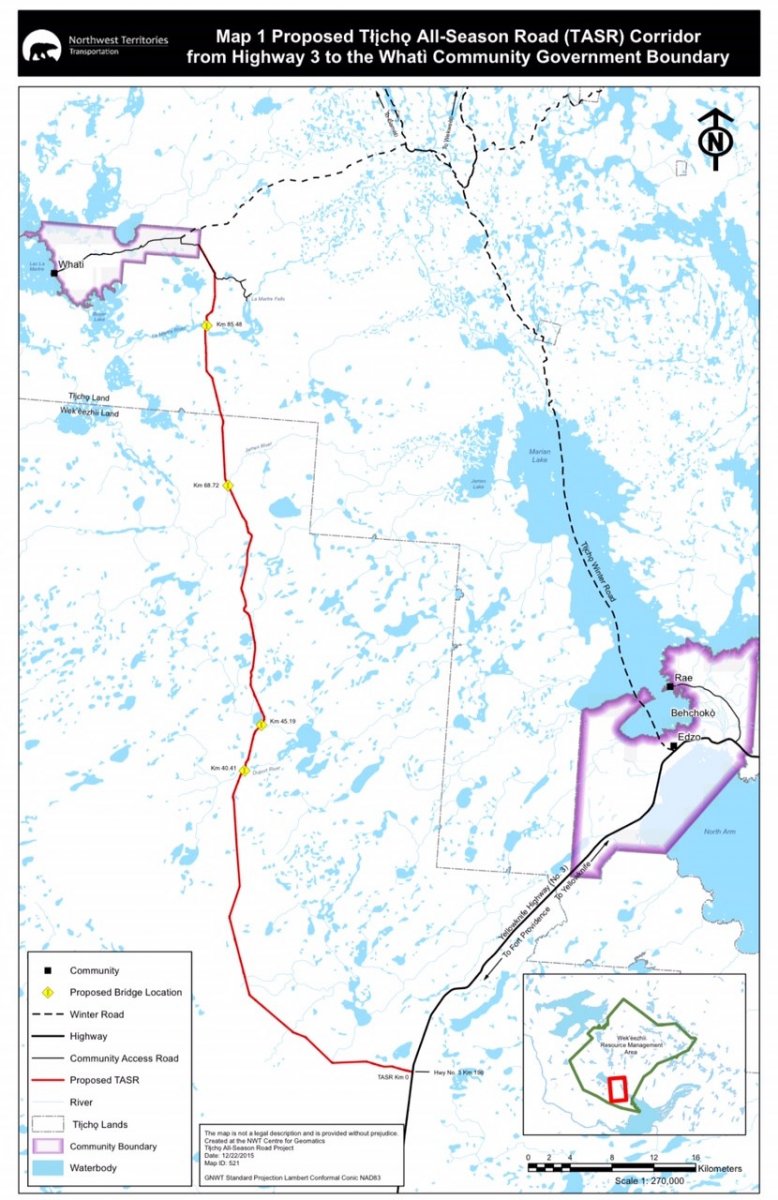
The road will start at kilometre 196 on Highway 3. The posted speed limit will be 70 kilometres per hour and large trucks will be able to drive the route. “You will be able to drive from Summerside, PEI, all the way to Whati with the same weight of truck,” McLeod says. “This is a national highway harmonization to try to get goods across Canada without changing weights and decoupling and restocking.”
The road will be built over three years, with construction slowing down in winter. North Star Infrastructure is dividing construction into four segments, starting with the Highway 3 entrance and building towards Whati.
McLeod says there were concerns about permafrost – studies done on the route show less than six per cent of the road will meet permafrost. He adds the company is working to lower this amount.
P3 with First Nations equity
The road is being built by Kiewit, under the project company North Star Infrastructure. The Tlicho Investment Corporation is also involved in the design process and the Tlicho Government has a 20 per cent ownership in the project.
This, McLeod says, is the first such project – a P3 or public-private partnership – where a First Nation has an equity investment.
Doing the project as a public-private partnership is cheaper McLeod says, referencing a study by Ernst & Young, however, it will remain to be seen how this analysis is proven or disproven throughout the 28 years of the project. “(The construction cost) is about generally what we would have paid for if we did it ourselves.”
The road will be operated by North Star for 25 years, after which it will be handed to the GNWT and paid for by the GNWT and the federal government in a 75 to 25 per cent split.
Benefits and economic impacts
“If you have a large construction group that’s on your doorstep, 300 people, 40 or 50 trucks, people need food and water and fuel. So local businesses who are in that business will have that opportunity for three years, so that’s quite a boost for them,” McLeod says. Hotels and other services will likely see a boost as well and youth who are getting into the job market could take advantage of this project.
“We certainly saw it in Inuvik and Tuk, lots of money being spent in the local community – everywhere from the general store to the hardware store all seeing a significant bubble in terms of business.”
The project has local hiring targets, as well as a system of bonuses and penalties if the company succeeds or fails to live up to the targets McLeod says. During construction, 35 per cent of the labour should be Tlicho, an NWT residents or a person hired by a Tlicho company. Twenty-five per cent of the business opportunties during construction should go to local firms. During operations and maintenance, the labour should be 55 per cent local increasing to 75 per cent over the 25 year period. “The expectation is that all these folks who do the maintenance of this should all be local – they either live in Behchoko, they live in Whati, this is their home,” McLeod says. “But we built in a training period.”
McLeod says ‘the sky is the limit’ in terms of what kinds of training can be offered over the 28 years of the project, including on-the-job training and official scholarships, apprentice positions and others.
The new road could also ‘theoretically’ allow the rest of the Tlicho winter road system to open sooner and close later. The Marion Lake section of the winter road, along the Whati stretch, is what McLeod calls the biggest issue and risk with building it each winter.
Providing confidence and access for mines in the region is another benefit. “There are a number of potential mines which will provide some employment long after the road is built,” McLeod says.